


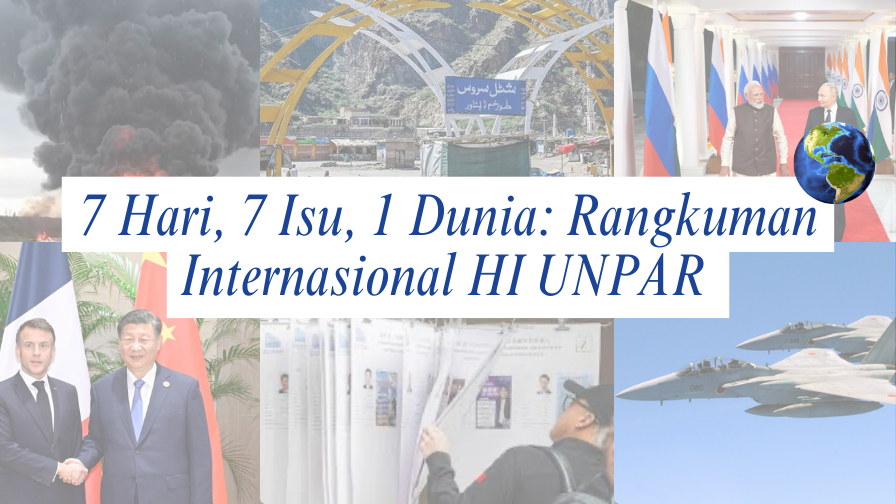
This week, global geopolitics once again showed rising tensions, marked by military escalations largely concentrated in Asia. Amid these dynamics, various countries intensified diplomatic efforts to maintain stability while opening channels for peaceful resolution.
Asia returned to the spotlight after China–Japan tensions escalated, following China’s move to lock its fighter jet’s fire-control radar on a Japanese aircraft over international waters near the Okinawa Islands. Tokyo condemned the action as “dangerous” and has lodged a formal protest with Beijing. Defense analysts view the incident as a serious threat, as radar lock-ons can be interpreted as a sign of imminent attack, forcing the targeted aircraft to take defensive maneuvers.
In South Asia, geopolitical frictions also heated up after an exchange of gunfire erupted along the Afghanistan–Pakistan border on Friday night (5/12), shortly after peace talks failed earlier in the week. Both sides accused each other of initiating the attack “without provocation,” before eventually agreeing to cease fire after shells hit residential areas. The escalation adds to the growing list of unresolved cross-border tensions.
Meanwhile, Hong Kong is striving to stabilize its domestic situation ahead of the legislative election, amid low voter turnout—reaching only 25.75 percent as of Sunday at 6:30 p.m. local time—and the aftermath of the Wang Fuk Court fire in Tai Po that killed around 159 people. The government extended voting hours, expanded polling station access, and provided support for vulnerable groups. Although Hong Kong Chief Executive John Lee urged citizens to exercise their voting rights as a political response to the Tai Po tragedy, parts of the public remain skeptical of the legitimacy of Hong Kong’s political processes.
In global diplomacy, President Vladimir Putin conducted a state visit to India. Putin met with Prime Minister Narendra Modi, attended a business forum, and participated in the launch of Russia Today in India—a Kremlin-funded media outlet. The two countries are expected to sign new cooperation agreements, even as New Delhi faces diplomatic pressure from the United States to reduce imports of Russian oil amid the ongoing war in Ukraine.
From Beijing, Euro-Asian diplomacy appeared to gain momentum through a meeting between French President Emmanuel Macron and Chinese President Xi Jinping on Thursday (4/12). Centered around two key issues—a proposed ceasefire in Ukraine and France’s €46 billion trade deficit with China in 2024—the two leaders reaffirmed their shared commitment to global stability. France also emphasized the need for more balanced economic relations and expressed hope that Macron’s visit would help boost Chinese investments in the country.
In Eastern Europe, the Russia–Ukraine conflict escalated as Moscow launched 653 drones and 51 missiles across various regions of Ukraine, targeting energy facilities and infrastructure. Ukraine managed to intercept most of the attacks, though 29 locations were affected and at least eight people were injured. In response, Ukraine launched drone strikes on the Ryazan oil refinery, but Russia claimed to have shot down 116 Ukrainian drones. The latest attacks coincided with a meeting between U.S. officials and a Ukrainian delegation in Florida to discuss a post-war security framework—progress that still hinges on Russia’s willingness to commit to long-term peace.
Finally, in Africa, armed violence intensified after Sudan’s paramilitary Rapid Support Forces (RSF) conducted a drone attack on a kindergarten in south-central Sudan, killing 50 people, including 33 children. Subsequent attacks targeted paramedics and civilian areas, prompting strong condemnation from UNICEF for the severe violation of international humanitarian law. The conflict between the RSF and the Sudanese military, ongoing since 2023, has killed more than 40,000 people and displaced 12 million, amid rising concerns about the risk of mass atrocities similar to those in El-Fasher.
Source:
“Sudanese paramilitary drone attack kills 50, including 33 children in Kordofan, doctor group says.” AP News. 6 December 2025. https://apnews.com/article/war-sudan-kordofan-drone-rsf-children-8fe0bb92a2db9977826be64f8a1119a2.
Blann, Susie. “Russia unleashes massive drone and missile attack on Ukraine as diplomatic talks continue.” AP News. 7 December 2025. https://apnews.com/article/russia-ukraine-war-drones-witkoff-trump-7f5e063223a426a4629b67c5991d1a73.
Christiastuti, Novi. “Perbatasan Afghanistan-Pakistan Memanas Lagi, Baku Tembak Terjadi.” detikNews. 6 Dcsember 2025. https://news.detik.com/internasional/d-8246270/perbatasan-afghanistan-pakistan-memanas-lagi-baku-tembak-terjadi.
Fadhil, Haris. “Tensi Tinggi! Jet Tempur China Kunci Radar Tembakan ke Pesawat Jepang.” detikNews. 7 December 2025. https://news.detik.com/internasional/d-8247458/tensi-tinggi-jet-tempur-china-kunci-radar-tembakan-ke-pesawat-jepang.
Haryono, Willy. “Pemilu Legislatif Hong Kong Dibayangi Kemarahan atas Kebakaran Maut.” Metro TV News. 7 December 2025. https://www.metrotvnews.com/read/kj2CDg38-pemilu-legislatif-hong-kong-dibayangi-kemarahan-atas-kebakaran-maut.
Jasmine, Adinda. “Macron Bertemu Xi Jinping, Bahas Gencatan Senjata di Ukraina.” Tempo. 4 December 2025. https://www.tempo.co/internasional/macron-bertemu-xi-jinping-bahas-gencatan-senjata-di-ukraina-2095919.
Rosenberg, Steve., Vikas Pandey. “Oil, defence and geopolitics: Why Putin is visiting Modi in Delhi.” BBC. 4 Desember 2025. https://www.bbc.com/news/articles/cj4q2vpggr9o.
Rosenberg, Steve., Vikas Pandey. “What Putin and Modi got out of Delhi meeting.” BBC. 5 December 2025. https://www.bbc.com/news/articles/c773v133xnxo.