


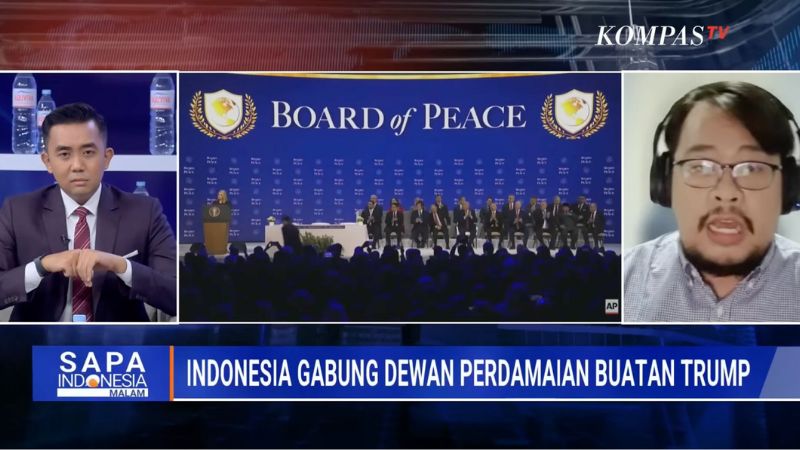
Bandung, 24 January 2026 – Kishino Bawono, S.IP., M.Sc., shared his perspective in a live broadcast with KompasTV regarding Indonesia’s decision to join the Board of Peace, an initiative established by U.S. President Donald Trump in Davos, Switzerland. Indonesia’s participation in the Board of Peace was marked by the signing of its charter by Indonesian President Prabowo Subianto. The Indonesian government views this move as a historic opportunity and a strategic chance to ensure that Gaza’s transition process remains aligned with the two-state solution. Indonesia has also emphasized the importance of preventing violence, protecting civilians, ensuring humanitarian access, and restoring Palestinian civil governance.
In his interview with KompasTV, Kishino expressed doubts about the direction of the Board of Peace, particularly in its capacity to realize peace for Palestine. He conveyed skepticism due to the Board’s structure, which he believes is heavily dominated by the United States, with Israel as another key actor—making it structurally different from the United Nations, which has balancing mechanisms among major powers. The Trump administration’s policies, which tend to favor Israel, could lead the Board of Peace to reflect Israeli interests more than to promote a fair and inclusive peace process.
For Indonesia, participation in the Board of Peace may offer certain strategic advantages. One potential benefit is the maintenance of strong relations with the United States, given President Trump’s frequent use of political and economic pressure—including tariff policies—as diplomatic tools. In this context, Indonesia’s involvement could help reduce the risk of bilateral tensions with the U.S.
Nevertheless, Kishino also highlighted significant risks, particularly with regard to Indonesia’s long-standing free and active foreign policy principle. He warned of Indonesia’s potentially weak position in influencing the Board’s policies and the possibility that the country could serve merely as symbolic legitimacy. Furthermore, the dominance of the United States and the limited presence of other major powers as counterbalances may constrain Indonesia’s ability to firmly advocate for the two-state solution and could undermine the independence of its diplomatic stance.
The interview video can be accessed here.