


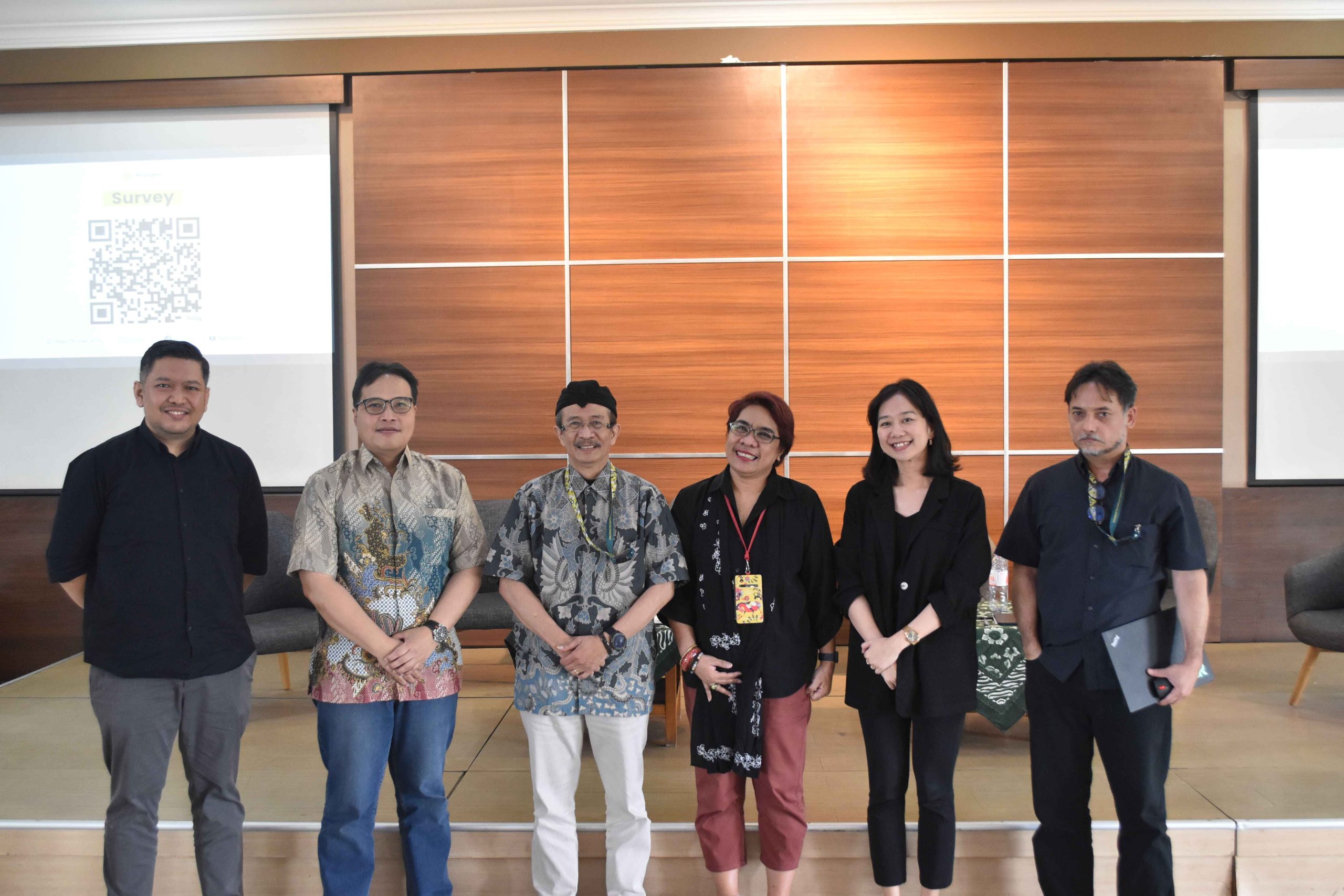
Bandung, 6 November 2025 – The International Relations Study Program at UNPAR once again held a public seminar with the theme “The Voice of Ciumbuleuit: Reviewing One Year of Prabowo’s Administration,” featuring several interdisciplinary academics to assess the performance of President Prabowo’s administration over the past year.
The seminar, held in the Veritas Room of Building 3 at FISIP UNPAR, featured four speakers: Adrianus Harsawaskita, S.IP., M.A., a lecturer in International Relations; Dr. Orpha Jane, a lecturer in Business Administration; Dr. Tristam Pascal Moeliono, S.H., M.H., LL.M., a lecturer at the Faculty of Law; and Wisnu Wardhono, Drs., MSIE., CMA. Through various academic perspectives, the speakers sought to provide critical analyses of the direction of Indonesia’s social, political, economic, legal, and foreign policies under the Prabowo-Gibran administration.
In her presentation, Dr. Orpha Jane highlighted social and political aspects, focusing on the role and participation of the younger generation in Indonesia’s political dynamics. She assessed that the first year of the Prabowo administration has encouraged young people, as digital natives, to become increasingly dominant and active in both Indonesian politics and business.
Meanwhile, Dr. Tristam Pascal Moeliono, S.H., M.H., LL.M., highlighted legal practices in Indonesia that tend to serve as instruments of state politics. He emphasized that when the law is used as a tool of power, can it still provide protection for society? Furthermore, Tristam explained that the law is a product of elite politics because academics and the public are not involved in the process of formulating public policy. Academics and the public only experience the impacts of these legal products.
From an economic perspective, Wisnu Wardhono, Drs., MSIE., CMA., reviewed the national economic performance. He explained the key factors behind the poor performance rating of the first year of the Prabowo administration, which received an average score of 3 out of 10 in a comprehensive assessment of its performance. He highlighted the administration’s major policies, such as Free Nutritious Meals, MSME empowerment, as well as challenges related to budget management, tax policy, corruption issues, and economic assistance programs.
The presentation continued with Adrianus Harsawaskita, S.IP., M.A., who discussed Indonesia’s foreign policy from the perspective of Performative Foreign Policy. He argued that Indonesia’s foreign policy under the Prabowo administration resembles a performer writing and enacting their own scenario. Through this performance, Indonesia’s diplomacy displays inconsistencies and undermines the principle of an independent and active foreign policy. According to him, the performativity exhibited by Prabowo actually reflects a lack of confidence on Indonesia’s global stage.
Through this interdisciplinary discussion, the speakers emphasized the importance of maintaining a critical stance toward public policy. Criticism of the system is not a form of rejection or hatred. A critical attitude demonstrates public concern and engagement in efforts to build better governance in accordance with Indonesia’s commitment to a democratic system that ensures the sovereignty of its people.