


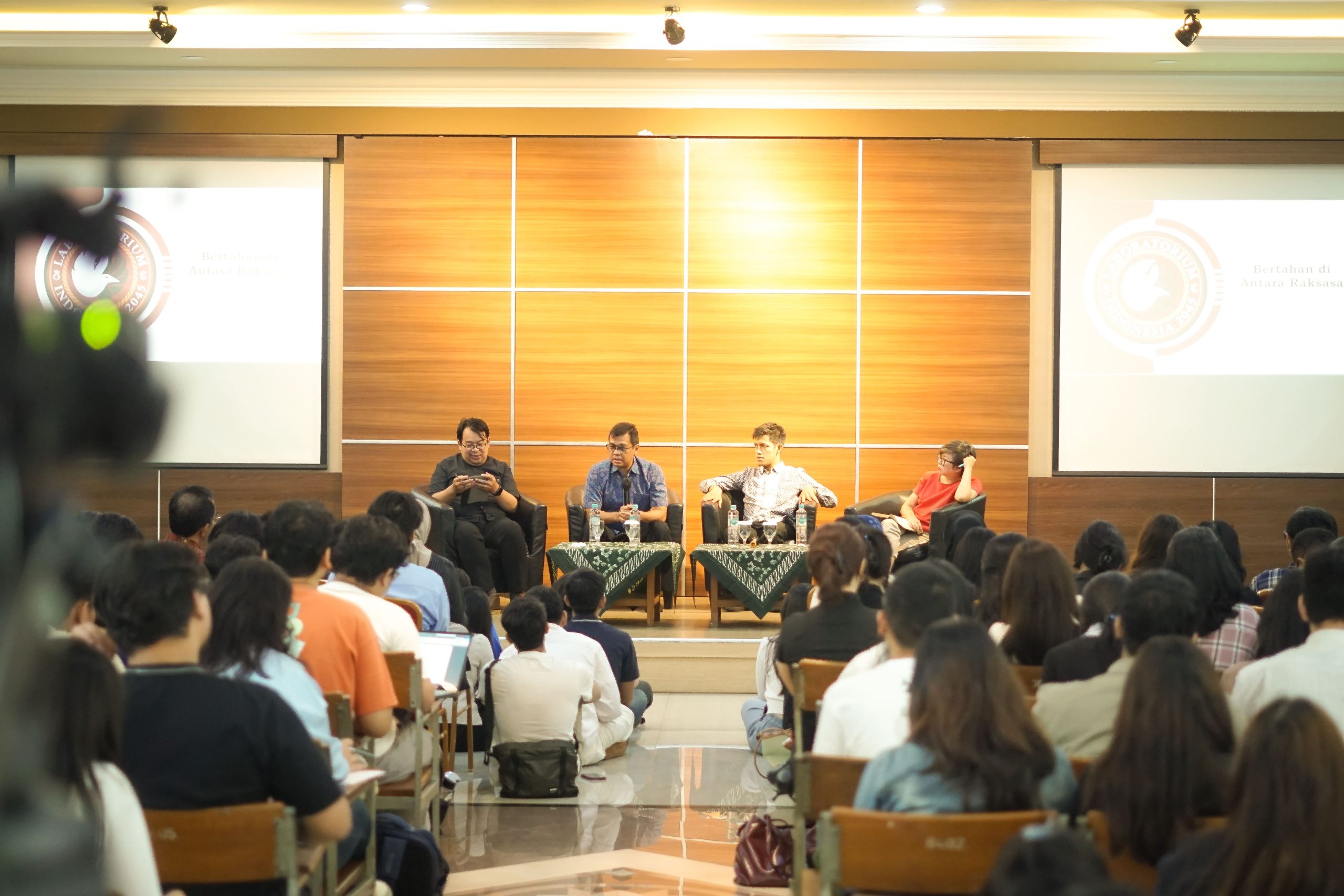
Bandung, 18 September 2025 — The International Relations Study Program of UNPAR held a public seminar titled “Weathering the Global Storm: Strategies for Small States to Resist Becoming Victims.” This seminar served as a pre-event for the International Conference on International Relations (ICON-IR) 2026, which the program will also host. As a pre-event, the seminar aligns closely with the upcoming conference’s theme, “The Weak [not] suffer what they must, the strong do what they can.” Both themes draw inspiration from two interconnected dynamics in contemporary global politics.
The first concerns the troubling state of today’s global order, marked by multiple crises—from humanitarian tragedies in Palestine, Sudan, Ukraine, and elsewhere; to the global climate crisis; persistent inequalities in both international and domestic economies; the U.S.–China trade war and tariff battles under President Trump; social crises related to gender equality and inclusion; the rise and mainstreaming of far-right movements, particularly in Western states; and the erosion of international norms as well as the effectiveness of Western liberal institutions.
The second dynamic revolves around the weakening of the so-called “rules-based international system” and the emergence of a survival-of-the-fittest world order where norms are no longer adhered to. In this “law of the jungle,” where power determines survival, small states lacking material capabilities face the greatest threats. By paraphrasing Thucydides’ Melian Dialogue, the public seminar and ICON-IR aim to explore ways small states can avoid becoming victims in today’s increasingly force-driven global landscape.
To address these background concerns, three speakers were invited to share their perspectives.
The first speaker, Andi Widjajanto, emphasized that ideally, Indonesia should pursue balancing—countering major power blocs—in global politics. However, given Indonesia’s current limitations, he argued that hedging becomes a more realistic strategy: a pragmatic approach that navigates between power centers to safeguard national interests. Hedging, he suggested, should be maintained until Indonesia is capable of implementing true balancing.
The second speaker, Zulfikar Rahmat, argued that to survive in contemporary global politics, Indonesia must understand its true position and diversify its diplomatic partnerships. He highlighted the Indonesia–China relationship, noting that the Indonesian government often frames the relationship as one where Indonesia needs China more than the other way around. This framing weakens Indonesia’s bargaining power in negotiations, leaving it at a disadvantage while China secures greater benefits. In reality, he stressed, China also needs Indonesia—as a source of raw materials and as a large market—given its “hungry” economy. Thus, Indonesia’s leverage should not be as weak as it currently appears. On diversification, Zulfikar emphasized that Indonesia must look beyond its traditional diplomatic partners and expand its outreach to non-traditional partners, such as countries in the Middle East and North Africa.
The final speaker, Evi Mariani, focused on non-state actors in international relations, particularly the interaction between the United States and other countries in the realm of journalistic values. She argued that the U.S.—and the West more broadly—can no longer be seen as the standard-bearer of ideal journalism, as the myth of journalistic objectivity has collapsed amid discriminatory practices against socially and economically marginalized groups. Journalism, she noted, cannot remain distant when structural injustice occurs; instead, it must take a stand to defend the oppressed in pursuit of a well-informed society.
In Indonesia, these problems are compounded by media that still orient themselves toward the West, remain concentrated among oligarchic groups, shift their engagement to social media and the internet, and face the paradox of “information clutter” alongside “news deserts.” So how can ordinary people—who are also part of the state and themselves “small actors” in global politics—survive? Evi stressed the importance of alternative media: small-scale platforms that create space for counter-narratives that do not necessarily align with the mainstream.