


Recent developments in global politics indicate an intensification of cross-regional tensions that are not only military in nature but also directly affect economic stability and global governance.
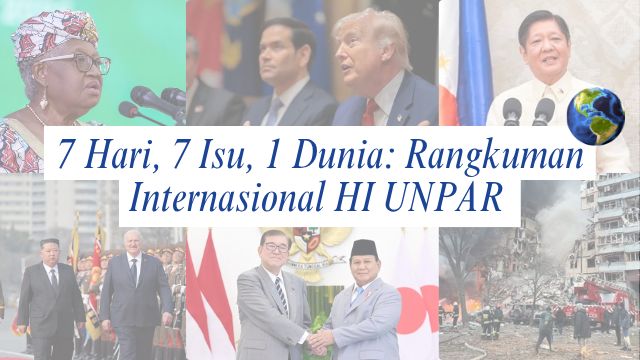
In Southeast Asia, President Ferdinand Marcos Jr. declared a one-year national energy emergency in Philippines due to disruptions in oil and gas supplies caused by the conflict between Iran, United States, and Israel. The closure of the Strait of Hormuz has further driven up global energy prices. In response, the Philippine government established a committee to maintain energy distribution and basic necessities, implemented energy-saving measures and fuel subsidies, cracked down on hoarding practices, and provided financial assistance of 5,000 pesos to transport workers alongside welfare programs for affected groups.
In Eastern Europe, Russia launched its largest air assault on Ukraine within a 24-hour period since the war began. The attack involved hundreds of drones and dozens of missiles targeting cities such as Lviv, Ivano-Frankivsk, Ternopil, and Vinnytsia. The strikes resulted in approximately eight fatalities and dozens of injuries, while also damaging civilian infrastructure, including historic buildings and hospitals. Ukrainian President Volodymyr Zelensky stated that the scale of the attack demonstrates Russia’s lack of intention to end the war, despite Ukrainian air defenses successfully intercepting most of the incoming threats.
In an effort to de-escalate tensions, U.S. President Donald Trump extended the deadline until April 6 for Iran to reach an agreement to end the conflict, while postponing planned strikes on Iranian energy facilities for 10 days. However, Iran rejected the proposal, deeming it unfair. The conflict, now ongoing for approximately one month, has resulted in thousands of casualties and significantly impacted the global economy, particularly through rising energy prices and disrupted supply chains due to the closure of the Strait of Hormuz. Despite indirect diplomatic communications through intermediary states, hostilities between Iran, the United States, and Israel continue, with the U.S. maintaining its demands for the cessation of Iran’s nuclear program and the reopening of critical energy routes.
Amid these global pressures, shifts in international alliances are also becoming evident. North Korea and Belarus strengthened bilateral ties through a friendship and cooperation agreement signed by Kim Jong-un and Alexander Lukashenko during Lukashenko’s official visit to Pyongyang. The agreement reflects deeper alignment amid Western sanctions, emphasizing the importance of cooperation among independent states to safeguard sovereignty, while also signaling solidarity within the non-Western bloc, including Russia and China. Both countries also expanded cooperation in sectors such as agriculture and information.
This situation coincides with increasing strain on the global trading system. The World Trade Organization faces a serious crisis during its ministerial meeting in Yaoundé amid global economic uncertainty driven by Middle Eastern conflicts and rising protectionism. Director-General Ngozi Okonjo-Iweala stated that the current disruption represents the most severe challenge in 80 years. The United States under Donald Trump is pushing for systemic changes through tariffs and smaller group cooperation, while China and the European Union hold differing views. Failure to achieve reform could risk the collapse and fragmentation of the global trading system.
In the realm of bilateral diplomacy, Indonesian Minister of State Secretariat Prasetyo Hadi stated that President Prabowo Subianto visited Japan to fulfill an invitation from Emperor Naruhito, followed by a meeting with Prime Minister Sanae Takaichi. The visit aims to strengthen bilateral relations and expand cooperation in key sectors, including trade, technology, education, forestry, and environmental issues.
Meanwhile, normative debates at the global level have intensified within the United Nations after the United States, Israel, and Argentina rejected a resolution declaring the transatlantic slave trade a crime against humanity and calling for reparations and the return of cultural artifacts. The resolution was supported by 123 countries, opposed by 3, and abstained by 52. U.S. Ambassador Dan Negrea emphasized that the United States does not recognize a legal basis for reparations for historical actions that were not illegal under international law at the time.
Sources:
“AS, Israel & Argentina Tolak Resolusi PBB soal Kejahatan Perbudakan”. CNN Indonesia. 28 Maret 2026. 2026. https://www.cnnindonesia.com/internasional/20260328150319-134-1342116/as-israel-argentina-tolak-resolusi-pbb-soal-kejahatan-perbudakan.
France-Presse, Agence. “North Korea and Belarus sign ‘friendship and cooperation’ treaty”. The Guardian. 26 Maret 2026. https://www.theguardian.com/world/2026/mar/26/north-korea-belarus-friendship-cooperation-treaty.
Gozzi, Laura., Jaroslav Lukiv. “Russia launches 948 drones at Ukraine in largest attack over 24-hour period”. BBC. 25 Maret 2026. https://www.bbc.com/news/articles/cz90gpyw90wo.
Hafezi, Parisa., Alexander Cornwell., dan Steve Holland. “Trump extends deadline for striking Iran’s energy plants into April”. Reuters. 27 Maret 2026. https://www.reuters.com/world/asia-pacific/trump-pauses-attacks-irans-energy-plants-says-talks-are-going-well-2026-03-26/.
“Negara Tetangga RI Umumkan Darurat BBM Nasional Gegara Perang Iran-AS”. CNN Indonesia. 25 Maret 2026. https://www.cnnindonesia.com/internasional/20260325084416-106-1341035/negara-tetangga-ri-umumkan-darurat-bbm-nasional-gegara-perang-iran-as.
Safitri, Eva. “Prabowo ke Jepang Diundang Kaisar Naruhito, Perkuat Kerja Sama”. detikNews. 29 Maret 2026. https://news.detik.com/berita/d-8420396/prabowo-ke-jepang-diundang-kaisar-naruhito-perkuat-kerja-sama.
“WTO holds crunch meeting amid growing uncertainty over multilateral system”. Aljazeera. 26 Maret 2026. https://www.aljazeera.com/news/2026/3/26/wto-holds-crunch-meeting-amid-collapsing-multilateral-system.