


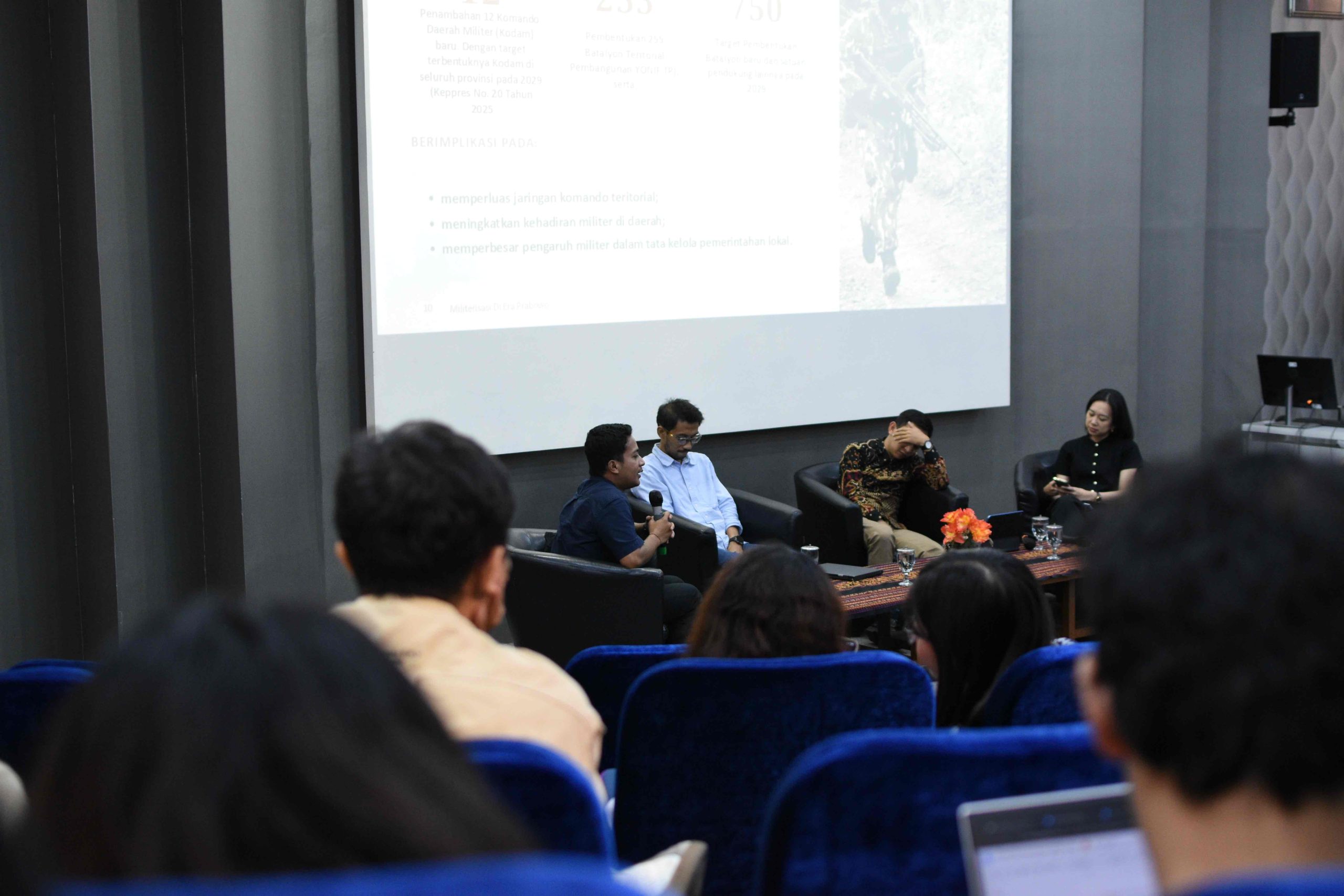
Bandung, November 5, 2026 – What does unity mean when society continues to face challenges in the economy, education, and democracy? This question became one of the central topics discussed at a public seminar titled Ngobrolin HI On Stage, themed “Persatuan Dicari, Per-Sate-an yang Dapat” (Unity Sought, Satay Received). The event was organized by the International Relations Study Program at Universitas Katolik Parahyangan (UNPAR) on Thursday (November 5) at the Audiovisual Room, Building 3, Faculty of Social and Political Sciences, UNPAR.
Drawing inspiration from Mohammad Hatta’s 1932 critique, “Persatuan Dicari, Per-Sate-an yang Dapat”, the event invited participants to reconsider how unity should be built amid the various challenges facing Indonesia. Coinciding with the commemoration of Youth Pledge Day, the discussion provided a platform to examine national issues from the perspectives of the economy, education, and democracy.
To address these three issues, Ngobrolin HI On Stage featured three speakers: Rangga Aditya Elias, Head of the International Relations Department at BINUS University; Iman Zanatul Haeri, Head of the Teacher Advocacy Division at the Association of Teachers and Educators (P2G); and Riyadh Putuhena, a researcher at Imparsial.
The discussion opened with Rangga Aditya Elias, who presented on “International Political Economy and Indonesia’s Economic Vulnerabilities”. In his presentation, Rangga highlighted several paradoxes in Indonesia’s economic conditions. On the one hand, economic growth and unemployment figures indicate positive developments. On the other hand, declining real wages and the shrinking proportion of workers earning middle-range incomes suggest that economic growth has not yet been fully accompanied by improvements in public welfare.
He also discussed Indonesia’s vulnerabilities in international trade, particularly the faster growth of imports compared to exports, dependence on several trading partners, and challenges related to energy security. According to him, the government needs to strengthen economic governance, diversify its trading partners, develop supply chains, and ensure that economic policies genuinely benefit the public. In this way, economic growth can be reflected not only in statistics but also in people’s everyday lives.
Next, Iman Zanatul Haeri addressed the topic of “The Direction of Prabowo-Gibran’s Education Policy, 2024–2026”. He highlighted several ongoing challenges in Indonesia’s education sector, ranging from literacy, mathematics, and science outcomes that have yet to show significant improvement to issues surrounding access to education and the welfare of educators.
Iman also examined various education policies, including the Free Nutritious Meals (Makan Bergizi Gratis or MBG) program, Sekolah Rakyat, and SMA Unggul Garuda. According to him, these programs need to be incorporated into a well-directed and integrated education system to prevent them from creating further challenges in the management of national education.
Furthermore, teachers’ issues were a major focus of his presentation. Various aspects, including teacher distribution, recruitment, competence, welfare, and protection, require more comprehensive improvements. He proposed simplifying teacher governance through a more integrated system and improving education regulations to ensure more equitable access to quality education.
Meanwhile, Riyadh Putuhena discussed “Militarization in the Prabowo Era”, examining developments in security sector reform and the expanding involvement of the military in civilian affairs. He explained that such involvement can be observed in various areas, ranging from the appointment of active military personnel to civilian positions and participation in non-defense programs to the military’s presence in academic institutions and public security matters.
Riyadh warned that the expansion of military roles beyond defense functions could lead to overlapping authorities with civilian institutions, weaken military professionalism, and restrict democratic space and public freedoms. He emphasized that strengthening the state does not necessarily require expanding the military’s role in civilian affairs. Instead, it requires strong and accountable civilian institutions, a professional military, and the preservation of civilian supremacy.
The three discussions demonstrated that the issue of Indonesian unity cannot be separated from various aspects of people’s lives. Economic welfare, quality education, and a healthy democracy are essential elements in building unity that is not merely expressed through slogans but can also be experienced by all members of society.
Through Ngobrolin HI On Stage, HI UNPAR hopes to continue providing a platform for discussions that bring students together with academics and practitioners to explore current issues. Beyond broadening their perspectives, the event also encourages students to examine national issues more critically and understand that domestic dynamics are closely interconnected with broader developments.