


Writer: Gracelia Yoshanty
Editor: Angelica Karin
The current global political landscape is marked by profound uncertainty. A series of recent developments—Donald Trump’s return to the U.S. presidency with unpredictable policies, China’s assertiveness as an aspiring superpower, Russia’s attempt to reaffirm its status as a regional great power, and the declining relevance of multilateralism and global governance—illustrate this turbulence. Meanwhile, Indonesia’s new administration is still adapting its foreign policy direction and appears somewhat shaky in responding to global challenges.
This situation raises an important question: Where does Indonesia stand in its foreign policy in 2025? The issue is relevant to Indonesia’s identity as a middle power with aspirations to serve as a hub for Global South countries, while carrying a historical legacy as a key actor that united Asian and African states through the 1955 Bandung Principles—now approaching their 70th anniversary.
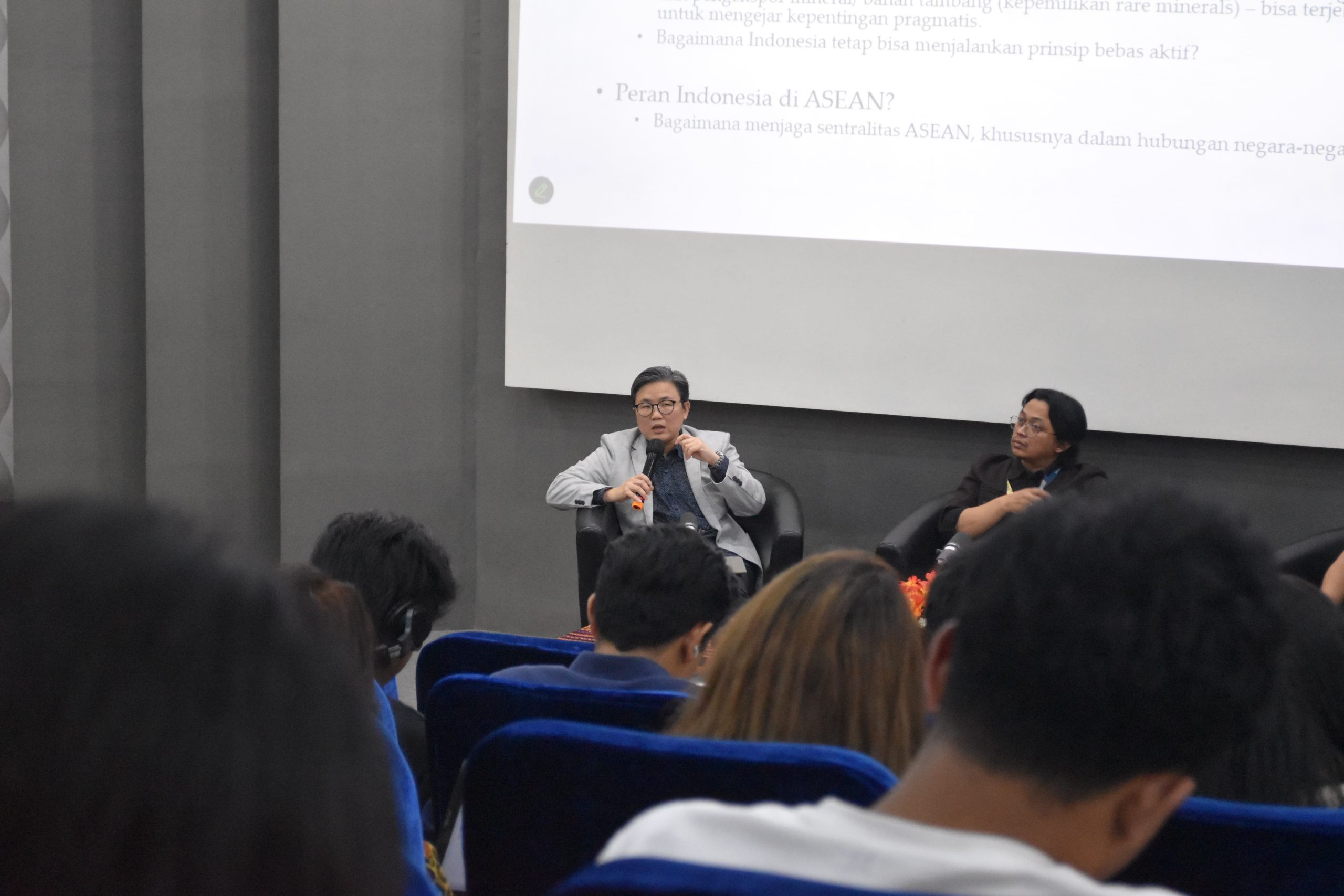
These themes became the core discussion of the public seminar “Indonesia and Global Politics: 70 Years of the Asian-African Conference, Great Power Politics, and the Global South,” organized by the International Relations Study Program of Parahyangan Catholic University (UNPAR) on Thursday, 27 February 2025. The seminar brought together three distinguished speakers:
- Dr. Lina A. Alexandra (Department of International Relations, Center for Strategic and International Studies/CSIS)
- Dr. Ahmad Rizky M. Umar (Department of International Politics, Aberystwyth University)
- Dr. Stanislaus Risadi Apresian (International Relations Study Program, UNPAR)
The event, attended by hundreds of participants, was held in a hybrid format from the FISIP UNPAR Advis Room and streamed live on the YouTube channel @Ngobrolin HI as the opening seminar of the 2024/2025 even semester.
Global Uncertainty and the Global South: Dr. Lina Alexandra
In her presentation, Dr. Lina Alexandra outlined today’s global political landscape and its implications for the Global South. Trump’s return to the U.S. presidency marks a major turning point. His administration has already taken decisive steps: a friendlier stance toward Russia, diminishing support for multilateralism, the imposition of tariffs on Chinese, Mexican, and Canadian goods, and the revival of the “Make America Great Again” agenda.
These policies transform the U.S. into a more transactional power—one that, according to Lina, has shifted “from being a norm champion to a norm violator.”
For Global South states like Indonesia, the uncertainty generated by these shifts has significant consequences. U.S. tariff policies against China force Global South countries into difficult choices, as these policies disrupt supply chains. Lina also highlighted the risks of economic politicization by great powers, which further undermine international cooperation—particularly among Global South countries. While these developments pose challenges, they also present strategic opportunities depending on how states perceive them.
Indonesia, now the newest member of BRICS, must prepare for potential U.S. retaliation. Washington has threatened to impose 100 percent tariffs on countries engaging in dedollarization, and Indonesia’s BRICS membership could also reduce its access to U.S. supply channels.
Indonesia and Global Climate Politics: Dr. Stanislaus Risadi Apresian
The second panelist, Dr. Stanislaus Risadi Apresian, examined Indonesia’s position in global climate politics—a topic receiving renewed attention since Trump announced the U.S. withdrawal from the Paris Agreement. This development raised the question of whether Indonesia should remain in the agreement.
According to Dr. Apresian, Indonesia must stay committed to the Paris Agreement. The U.S. exit, he argued, should not influence Indonesia’s stance, as the U.S. has entered and exited the agreement multiple times depending on its leadership. The Paris Agreement will not collapse simply because the U.S. leaves.
For Indonesia—a Global South country deeply dependent on natural resources—environmental issues are critical because the nation’s survival is tied to ecological sustainability. “Imagine if every country followed the U.S. exit; it would lead to tragedy,” he emphasized. Leaving the Paris Agreement would contradict the principles Indonesia championed during the Asian-African Conference.
Relevance of the Asian-African Conference Today: Dr. Ahmad Rizky M. Umar
Joining virtually from the United Kingdom, Dr. Ahmad Rizky M. Umar discussed the relevance of the Asian-African Conference (AAC) to current global politics. Indonesia played a central role in initiating the 1955 conference, which produced key principles—independence, racial equality, cultural equality, decolonization, and the rise of Third World nationalism.
Umar argued that Indonesia must reclaim its leadership role in shaping the international order, just as it did seven decades ago. He outlined six strategic points Indonesia must pursue:
- Developing a strategic vision for the international order
- Addressing emerging tensions through diplomacy
- Confronting major geopolitical, geostrategic, and geoeconomic challenges
- Assuming leadership responsibilities, such as chairing ASEAN
- Initiating trans-regional cooperation
- Reinforcing multilateralism