


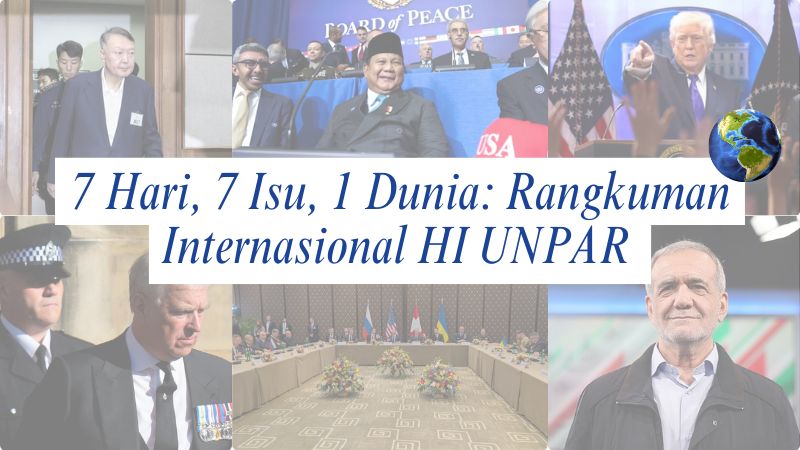
A number of political and security developments have shaped the global landscape over the past week.
In East Asia, the Seoul Central District Court sentenced former South Korean President Yoon Suk Yeol to life imprisonment on charges of leading an insurrection following his attempt to impose martial law in December 2024 and deploy troops to the National Assembly. The judges ruled that the actions were intended to paralyze legislative functions and violated the constitution, despite the plan ultimately failing. Prosecutors had previously sought the death penalty, while Yoon retains the right to appeal. The case forms part of a broader political crisis that resulted in his removal from office and triggered demonstrations by both supporters and opponents outside the court.
In the Middle East, Indonesian Foreign Minister Sugiono emphasized that Indonesia’s appointment as Deputy Commander of the International Stabilization Force ISF is not related to diplomatic recognition of Israel. Indonesia has set clear limits, stating that it will not engage in military operations or disarmament efforts, and will instead focus on civilian protection and humanitarian missions. Indonesia also holds an operational role as one of the countries contributing the largest number of troops. At the Board of Peace meeting, President Prabowo Subianto reaffirmed Indonesia’s commitment to deploy eight thousand Indonesian National Armed Forces personnel to Gaza and expressed readiness to increase the number if necessary.
Meanwhile, United States President Donald Trump imposed a 15 percent global import tariff under Section 122 of the Trade Act of 1974 after the Supreme Court annulled a previous tariff policy on the grounds that it exceeded presidential authority. The temporary tariff may remain in effect for approximately five months before requiring congressional approval and maintains separate tariffs for several strategic sectors. The ruling also opens the possibility of reclaiming previously collected tariff revenues, although the mechanism remains unclear, and has sparked debate among business actors and U.S. trading partners.
In South Asia, on Sunday 22 February, Pakistan conducted a series of airstrikes in Afghanistan territory, claiming to target militant groups, including the Pakistani Taliban and ISIS affiliates, in response to a series of suicide bombings in Pakistan. The Afghanistan government stated that the strikes in Nangarhar and Paktika killed and injured dozens of people, including women and children, and described the action as an attempt to conceal Pakistan’s security shortcomings. The operation marked the largest escalation since border clashes in October, amid deteriorating relations between the two countries since 2021.
In the United Kingdom, police arrested former Prince Andrew on suspicion of misconduct in public office related to his association with Jeffrey Epstein. He was detained for 11 hours before being released under investigation without charges. The arrest represents the first detention of a member of the royal family in several centuries and adds pressure on the British monarchy, while King Charles III stated that due legal process must take its course.
Meanwhile, Iranian President Masoud Pezeshkian asserted that Iran will not yield to external pressure in nuclear negotiations with the United States. Speaking in Tehran, he reaffirmed the government’s commitment to resilience, national unity, and state dignity, and urged citizens to set aside differences amid mounting challenges. The statement was delivered amid heightened tensions between Iran and the United States, following an increased U.S. military presence in the Middle East and two rounds of indirect nuclear negotiations held this month in Muscat and Geneva concerning Iran’s nuclear program and the potential lifting of U.S. sanctions.
In Europe, negotiations between Russia, Ukraine, and the United States in Geneva failed to produce a breakthrough despite progress on military issues such as front line positioning and ceasefire monitoring. Ukrainian President Volodymyr Zelensky described the talks as difficult due to sharp differences over Russia’s demands regarding the Donbas region and the status of the Zaporizhzhia Nuclear Power Plant. Both sides agreed to continue negotiations amid ongoing attacks in Ukraine
Source:
Borowiec, Steven., Kim Jaewon. “South Korean ex-President Yoon receives life sentence for insurrection”. Nikkei Asia. 19 Februari 2026. https://asia.nikkei.com/politics/south-korean-ex-president-yoon-receives-life-sentence-for-insurrection?utm_campaign=IC_one_time_free&utm_medium=email&utm_source=NA_newsletter&utm_content=article_link&seq_num=4&si=a672aa6b-d261-4188-bd3f-4e46ca17a7f5.
Gozzi, Laura. “‘Difficult’ Russia-Ukraine peace talks end without breakthrough”. BBC. 18 Februari 2026. https://www.bbc.com/news/articles/c0k1xj0d708o.
Jordan, dearbail. “Trump says he will increase his new global tariffs to 15%”. BBC. 22 Februari 2026. https://www.bbc.com/news/articles/cn8z48xwqn3o.
“Menlu: RI Jadi Wakil Komandan ISF Tak Terkait Hubungan dengan Israel” CNN Indonesia 21 Februari 2026. https://www.cnnindonesia.com/internasional/20260221082306-134-1330248/menlu-ri-jadi-wakil-komandan-isf-tak-terkait-hubungan-dengan-israel.
Muhaimin. “Pakistan Bombardir Afghanistan di Tengah Ramadan, Puluhan Orang Tewas dan Luka”. Sindonews. 22 Februari 2026. https://international.sindonews.com/read/1679623/40/pakistan-bombardir-afghanistan-di-tengah-ramadan-puluhan-orang-tewas-dan-luka-1771736559?showpage=all.
Smith, Alexander., Jean-Nicholas Fievet. “Former Prince Andrew arrested following Epstein files revelations”. NBC News. 19 Februari 2026. https://www.nbcnews.com/world/united-kingdom/former-prince-andrew-arrested-epstein-files-revelations-rcna259691.
Xinhua. “Iran tegaskan ketahanan di tengah perundingan nuklir dan tekanan AS”. Antara News. 22 Februari 2026. https://www.antaranews.com/berita/5430422/iran-tegaskan-ketahanan-di-tengah-perundingan-nuklir-dan-tekanan-as.