


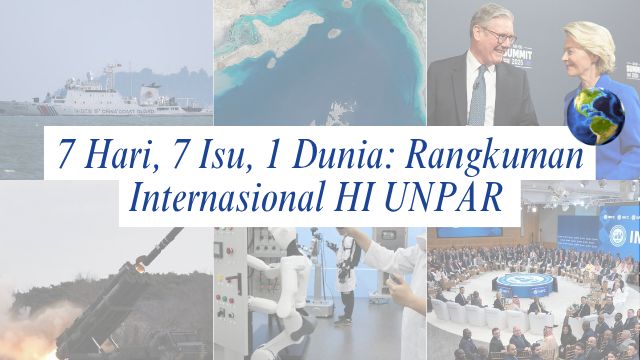
Global developments over the past week have demonstrated complex dynamics, marked by efforts to de-escalate conflicts, rising security tensions, and pressures on global economic stability.
In the Middle East, Iran announced the full reopening of global oil trade routes through the Strait of Hormuz during a 10 day ceasefire period between Israel and Lebanon. Foreign Minister Seyed Abbas Araghchi stated that commercial vessels could pass through coordinated routes designated by Iran’s maritime authorities. United States President Donald Trump welcomed the decision to reopen the Strait of Hormuz. Previously, Iran had closed the strait as a form of pressure against the United States and Israel, raising concerns over an energy crisis and rising global oil prices. The situation escalated further after the United States blockaded Iranian vessels following the failure of peace negotiations in Islamabad regarding demands to halt Iran’s nuclear program.
In Europe, the United Kingdom is seeking to strengthen its relationship with the European Union through a pragmatic approach amid global instability, including the war in Ukraine and the impact of the Iran conflict. Cooperation is focused on sectors such as security and the economy, including food, carbon emissions, and youth exchange, without returning to EU membership. This policy has sparked domestic debate, as it is seen as potentially aligning the UK with EU regulations, while the government maintains that the approach remains consistent with Brexit principles.
Turning to Asia, China issued a strong protest against Japan after a Japan Self Defense Forces warship entered the Taiwan Strait. This action was viewed as a threat to China’s sovereignty and security. Beijing described it as a deliberate military provocation that could worsen bilateral relations, particularly amid prior tensions related to statements by the Japanese Prime Minister concerning Taiwan. China emphasized that the Taiwan issue represents a red line in China Japan relations and urged Tokyo to exercise restraint.
Meanwhile, on Sunday April 19, North Korea launched several ballistic missiles from the Sinpo area toward waters between the Korean Peninsula and Japan. South Korea described the launch as a violation of United Nations resolutions and is continuing to analyze the missile specifications. The missiles reportedly traveled approximately 140 kilometers. This incident occurred following calls for diplomacy from the International Atomic Energy Agency. South Korea reaffirmed its military readiness to respond to provocations. Japan and the United States will also coordinate, with assessments indicating no immediate threat.
The Russia Ukraine conflict continues to escalate, with drone and missile attacks on Ukraine killing three people and injuring at least ten in Kyiv. Fires also broke out due to missile debris in the Obolensky district. A separate attack in Dnipro killed one person and injured ten others, with one victim in critical condition. Since the beginning of the war, Russia has launched hundreds of drones nearly every night and expanded attacks into daytime operations. Meanwhile, Ukraine has also carried out strikes on Russia, resulting in the deaths of two children in the Krasnodar Krai region following a drone attack on a residential building.
Amid these developments, global financial leaders at the IMF and World Bank meetings in Washington highlighted the significant impact of geopolitical shocks, particularly the conflict in the Middle East, which has triggered rising energy prices and supply disruptions. Optimism briefly emerged following the reopening of the Strait of Hormuz but faded due to renewed attacks. The IMF lowered its global growth projection for 2026 to 3.1% and warned of a potential decline to 2.5% or a recession if conflicts persist. The IMF and World Bank also pledged assistance of up to 150 billion US dollars, while acknowledging that the direction of the global economy now heavily depends on political dynamics between the United States and Iran.
On another front, technological developments have also drawn attention through the success of the humanoid robot Lightning developed by the Chinese company Honor. The humanoid robot set a record by completing a 21 kilometer half marathon in Beijing in 50 minutes and 26 seconds, surpassing the human world record. This achievement reflects the rapid advancement of China’s robotics technology amid global competition, with autonomous navigation capabilities and high propulsion power as key factors behind its success.
Source:
Adler, Katya. “UK seeks closer EU ties in volatile times – but at what cost?”. BBC. 17 April 2026. https://www.bbc.com/news/articles/cqj8pg5yppwo.
“Iran Umumkan Buka Selat Hormuz Selama Gencatan, Trump Semringah”. CNN Indonesia. 17 April 2026. https://www.cnnindonesia.com/internasional/20260417202250-120-1349306/iran-umumkan-buka-selat-hormuz-selama-gencatan-trump-semringah.
Lau, Chris., dan Beijing Bureau. “A Chinese android just ran a half-marathon faster than any human ever”. CNN. 19 April 2026. https://edition.cnn.com/2026/04/19/china/china-robot-half-marathon-intl-hnk.
Muhaimin. “Kapal Perang Sekutu AS Masuk Selat Taiwan, China Marah”. SindoNews. 19 April 2026. https://international.sindonews.com/read/1697783/40/kapal-perang-sekutu-as-masuk-selat-taiwan-china-marah-1776560673?showpage=all.
Shalal, Andrea., David Lawder., dan Libby George. “IMF, World Bank meetings show limits in mitigating shock, reliance on US for solutions”. Reuters. 19 April 2026. https://www.reuters.com/world/asia-pacific/imf-world-bank-meetings-show-limits-mitigating-shocks-reliance-us-solutions-2026-04-19/.
Shalvey, Kevin., Anthony Trotter., dan Joohee Cho. “Nort Korea test-launches ‘multiple’ ballistic missiles, South Korea says”. ABC News. 19 April 2026. https://abcnews.com/International/north-korea-test-launches-multiple-ballistic-missiles-south/story?id=132180013.
Zaenuddin, Muhammad. “Rusia Luncurkan Serangan Udara ke Ukraina: 3 Tewas, 10 Luka”. Kompas,com. 16 April 2026. https://internasional.kompas.com/read/2026/04/16/102338170/rusia-luncurkan-serangan-udara-ke-ukraina-3-tewas-10-luka.