


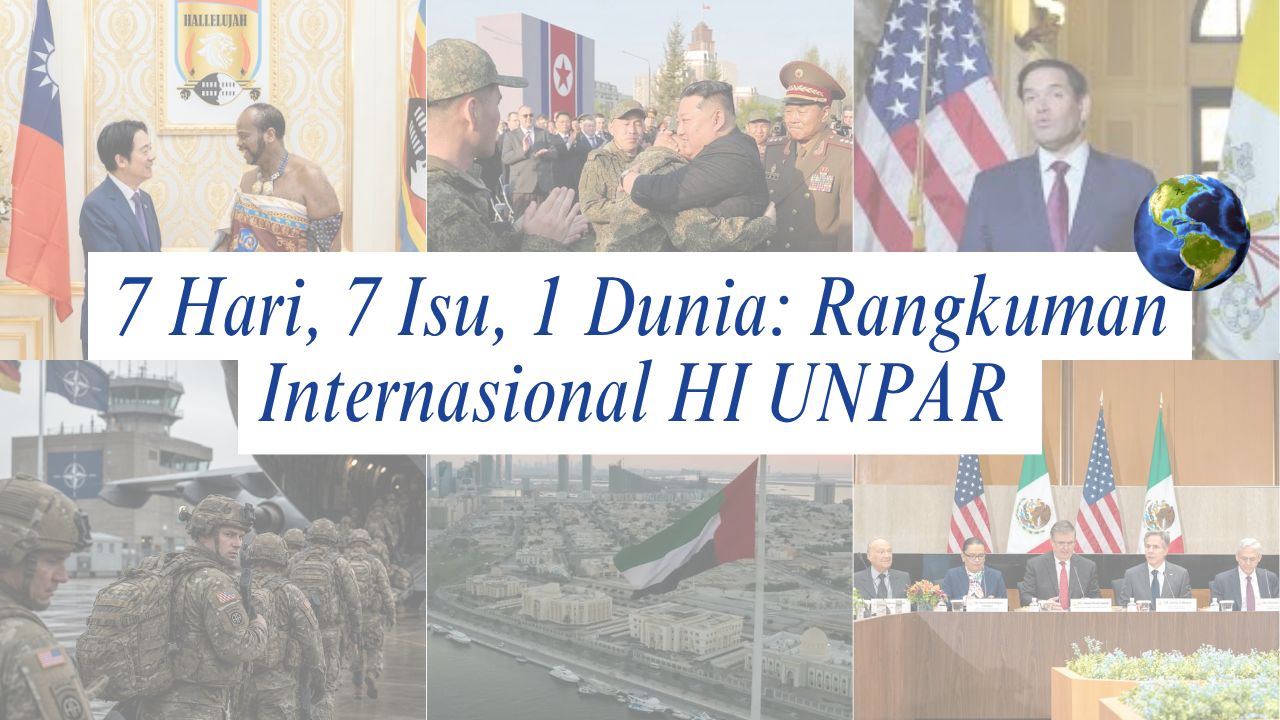
Global developments over the past few days have reflected an increasingly dynamic landscape, marked by rising geopolitical tensions, intensified diplomatic efforts, and shifts in economic and security policies across regions.
In East Asia, Taiwan’s President Lai Ching-te arrived in Eswatini after his visit was previously delayed due to China’s pressure on African countries to deny overflight permits. The visit was not announced in advance and was carried out through careful diplomatic arrangements, with an agenda including a meeting with King Mswati III and the signing of cooperation agreements. China condemned the visit and reiterated its position that Taiwan is part of its territory, while urging Eswatini to end diplomatic relations with Taiwan. Meanwhile, Taiwan emphasized its commitment to maintaining international engagement despite external pressure, as China also removed tariffs for African countries except Eswatini.
Meanwhile, in North Korea, leader Kim Jong Un praised troops who chose suicide over capture while fighting in Ukraine. The statement serves as an explicit acknowledgment of a previously suspected military doctrine and highlights North Korea’s involvement in Russia’s war. The memorial complex records thousands of fallen soldiers, while reports indicate that more than 10,000 North Korean troops have been deployed to Russia’s Kursk region, with significant casualties. The existence of captured soldiers also raises legal and humanitarian concerns regarding their repatriation after the conflict.
In the Middle East, Iran has proposed a new 14-point peace plan to the United States aimed at permanently ending the war. The proposal includes demands for a ceasefire within 30 days, lifting sanctions, releasing frozen assets, withdrawing US forces, war reparations, and establishing a new mechanism in the Strait of Hormuz. US President Donald Trump stated that he is reviewing the proposal but remains doubtful about reaching an agreement, emphasizing Iran’s nuclear issue as a red line. Despite a ceasefire in place since April 8, tensions persist, including blockades and naval confrontations in the Strait of Hormuz, while differing interests and mutual distrust continue to hinder negotiations.
Diplomatic efforts are also evident in US Secretary of State Marco Rubio’s planned visit to Rome, aimed at repairing strained relations with Italy and the Vatican following President Donald Trump’s criticism of Pope Leo regarding the US-Israel war on Iran. Rubio is scheduled to meet key officials including Vatican Secretary of State Pietro Parolin and Italian Foreign Minister Antonio Tajani, while a meeting with Prime Minister Giorgia Meloni remains uncertain. The visit takes place amid threats of US troop withdrawals from several European countries and differing positions on the use of military bases in the Iran conflict, further complicating relations between the US and its allies.
At the same time, the US military plans to withdraw approximately 5,000 troops from Germany over the next six to twelve months amid rising tensions with European allies regarding the war against Iran. The Pentagon’s decision followed criticism from German Chancellor Friedrich Merz, prompting a response from President Donald Trump, who described the remarks as counterproductive. The move is also influenced by US dissatisfaction with European support, while criticism of the war continues to grow due to its impact on the global economy and energy supply disruptions.
In the energy sector, the United Arab Emirates has officially withdrawn from OPEC after being a member since 1967. The decision aims to safeguard national interests and adjust long-term economic strategy amid changes in domestic energy structure. As a result, the UAE is no longer bound by production quotas and can manage output more flexibly in a tense global energy market affected by Middle East conflicts. This move follows a broader trend of countries such as Angola, Qatar, Indonesia, and Ecuador exiting OPEC due to domestic priorities, energy transitions, and the need for production flexibility.
Meanwhile, in Latin America, several high-ranking Mexican government and law enforcement officials have been charged in New York for allegedly collaborating with the Sinaloa cartel in distributing drugs into the United States in exchange for bribes and political support. Among the accused is Sinaloa Governor Ruben Rocha Moya, who has denied all allegations. The defendants are suspected of protecting cartel operations, leaking sensitive information, and facilitating criminal activities including kidnapping and murder, in exchange for millions of dollars from the Chapitos faction. Mexican authorities have stated they will conduct their own investigation in accordance with domestic legal procedures.
Source:
Giuffrida, Angela. “Marco Rubio to visit Rome, reportedly to ‘thaw’ US relations with Pope and Meloni”. The Guardian. 3 Mei 2026. https://www.theguardian.com/us-news/2026/may/03/marco-rubio-visits-rome-pope-leo-us-italy-relations.
Katersky, Aaron. “US charges Mexican government, law enforcement officials in alleged cartel scheme”. ABC News. 30 April 2026. https://abcnews.com/International/us-charges-mexican-government-law-enforcement-officials-alleged/story?id=132516563.
Ripley, Will. “Kim Jong Un praises soldier suicides, signals deepening role in Russia’s war”. CNN. 30 April 2026. https://edition.cnn.com/2026/04/30/asia/north-korea-soldier-suicides-intl-hnk.
Shankar, Priyanka. “What’s Iran’s 14-point proposal to end the war? And will Trump accept it?”. Aljazeera. 3 Mei 2026. https://www.aljazeera.com/news/2026/5/3/whats-irans-14-point-proposal-to-end-the-war-and-will-trump-accept-it.
Syarifudin. “Marah Tak Dibantu dalam Perang Iran, AS akan Tarik 5.000 Tentara dari Jerman”. Sindonews. 2 Mei 2026. https://international.sindonews.com/read/1702463/42/marah-tak-dibantu-dalam-perang-iran-as-akan-tarik-5000-tentara-dari-jerman-1777694727?showpage=all.
“Taiwan president visits Eswatini days after blaming China for cancelled trip”. BBC. 3 Mei 2026. https://www.bbc.com/news/articles/c809ln029ldo.
Tirta, Emanuella Bungasmara Ega. “ UAE Cabut dari OPEC, Daftar NEgara Keluar Bertambah”. CNBC Indonesia. 3 Mei 2026. https://www.cnbcindonesia.com/research/20260503105622-128-731772/uae-cabut-dari-opec-daftar-negara-keluar-bertambah.