


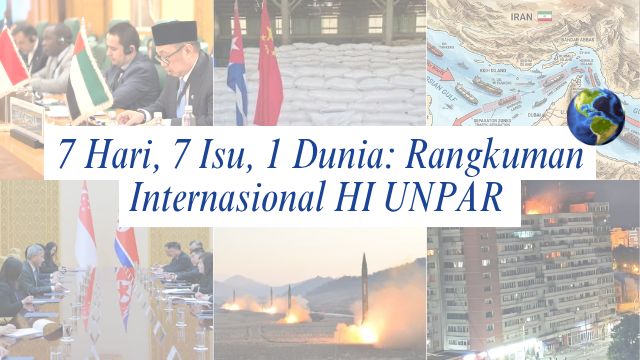
As the year enters its midpoint, global political dynamics continue to be shaped by cross regional tensions that show little sign of de escalation. Amid efforts by various actors to promote dialogue and encourage peaceful resolutions, conflicts and geopolitical rivalries continue to evolve, reflecting the complexity of the challenges facing the international community today.
Indonesia, alongside 17 countries from the Middle East and Africa, condemned the planned opening of a Somaliland Embassy to Israel in Jerusalem. In a joint statement issued by their foreign ministers, the move was described as inconsistent with international law and potentially encouraging separatism. The criticism followed Israel’s recognition of Somaliland’s independence in December 2025, making it the first country to do so officially. The recognition paved the way for Somaliland’s planned embassy in Israel, while Israel also intends to establish an embassy in Hargeisa, Somaliland’s capital. Through the statement, the 18 countries reaffirmed their support for the unity, sovereignty, and territorial integrity of the Federal Republic of Somalia, while rejecting any actions deemed capable of undermining the country’s sovereignty.
Meanwhile, Cuba received food assistance from China as the country continues to face a worsening economic crisis compounded by pressure from the United States. A shipment of 15,000 tons of rice arriving at the Port of Havana marked the first installment of the 60,000 tons pledged by Beijing. Chinese Ambassador to Cuba Hua Xin described the delivery as the largest food aid package provided by China to Cuba in recent years. The assistance is widely viewed as a demonstration of Beijing’s support for one of its strategic partners in the Caribbean amid prolonged economic difficulties.
Attention also turned to US Iran relations, which have shown little meaningful progress despite ongoing discussions regarding a possible agreement on security in the Strait of Hormuz. Tensions escalated after Iranian military officials stated that four vessels attempting to pass through the strait were forced to turn back following warning shots from US forces. Washington maintained that the action was defensive in nature and intended to preserve stability while upholding the existing ceasefire. However, the statement appeared to contrast with President Donald Trump’s remarks during a cabinet meeting, where he asserted that no country should control the strategic maritime route. Uncertainty surrounding security conditions in the Strait of Hormuz also affected global energy markets, with oil prices initially falling by more than five percent before rebounding by nearly two percent.
In Europe, tensions between Russia and Western countries resurfaced after a Russian drone struck an apartment building in Romania on Friday (29/5). The incident, which occurred within the territory of a NATO member state, injured two people and prompted the deployment of two F 16 fighter jets. The event drew condemnation from several NATO members. President of the European Commission Ursula von der Leyen stated that the attack had crossed a red line and reaffirmed the European Union’s commitment to strengthening deterrence capabilities along its eastern border while increasing pressure on Russia. NATO also expressed full solidarity with Romania and condemned what it described as reckless actions by Moscow.
In East Asia, North Korea once again heightened regional tensions by launching a ballistic missile into the Yellow Sea on Tuesday (26/5). Over recent weeks, Pyongyang has conducted a series of missile tests, with South Korean military officials estimating that the latest missile traveled approximately 80 kilometers. The situation has increased concerns in Seoul, particularly after North Korea repeatedly rejected efforts to improve bilateral relations and referred to South Korea as its “number one enemy.” In response, South Korea, the United States, and Japan have strengthened coordination and intelligence sharing regarding regional security developments.
Amid growing tensions on the Korean Peninsula, Singapore’s Foreign Minister Vivian Balakrishnan visited both Pyongyang and Seoul. During the discussions, the South Korean government once again proposed dialogue aimed at peaceful coexistence with North Korea. South Korean Foreign Minister Cho Hyun stated that Seoul had conveyed its willingness to engage in talks through Singapore as an intermediary. However, the initiative has yet to receive a clear response from Pyongyang.
Meanwhile, discussions surrounding a potential peace agreement between the United States and Iran have also become intertwined with broader Middle Eastern political dynamics. Trump urged Arab states to sign the Abraham Accords, a framework for normalizing diplomatic relations with Israel that he described as a key requirement for a more comprehensive regional agreement. However, the proposal drew criticism for allegedly failing to adequately address the Palestinian issue. Saudi Arabia, one of the primary countries encouraged to join the agreement, reiterated that the establishment of an independent Palestinian state remains a fundamental prerequisite before normalization with Israel can take place.
Source:
”Drone Rusia Serang Negara NATO! 2 Jet Tempur Dikerahkan Buat Cegat.” CNN Indonesia. 29 Mei 2026. https://www.cnnindonesia.com/internasional/20260529161546-134-1363472/drone-rusia-serang-negara-nato-2-jet-tempur-dikerahkan-buat-cegat.
Aulia, Luki. “Trump Desak Arab Saudi dan Pakistan Akui Israel sebagai Syarat Damai AS-Iran,” Kompas. 26 Mei 2026. https://www.kompas.id/artikel/trump-desak-arab-saudi-dan-pakistan-akui-israel-sebagai-syarat-damai-as-iran?open_from=Internasional_Page.
Difa, Yashinta. “Indonesia kutuk rencana ilegal Somaliland buka kedutaan di Yerusalem.” Antara. 24 Mei 2026. https://www.antaranews.com/berita/5580680/indonesia-kutuk-rencana-ilegal-somaliland-buka-kedutaan-di-yerusalem.
Ferida, Khairisa. “Indonesia dan 17 Negara Lainnya Kutuk Pembukaan Kedutaan Somaliland di Yerusalem.” Liputan6. 25 Mei 2026. https://www.liputan6.com/global/read/7235259/indonesia-dan-17-negara-lainnya-kutuk-pembukaan-kedutaan-somaliland-di-yerusalem.
Ford, Matt. “Cuba receives China rice shipment amid US threats, blackouts.” DW. 24 Mei 2026. https://www.dw.com/en/cuba-receives-china-rice-shipment-amid-us-threats-blackouts/a-77281770.
Hutapea, Rita Uli. “Korut Luncurkan Rudal Balistik ke Laut Kuning.” detikNews. 26 Mei 2026. https://news.detik.com/internasional/d-8505791/korut-luncurkan-rudal-balistik-ke-laut-kuning?page=2.
Nababan, Helena Fransisca. “Menlu Singapura Kunjungi Dua Korea, Perkuat Hubungan Diplomatik.” Kompas. 27 Mei 2026. https://www.kompas.id/artikel/menlu-singapura-kunjungi-dua-korea-perkuat-hubungan-diplomatik?open_from=Internasional_Page.
Santosa, Iwan. “Kecuali UEA, Negara Arab Kecam Perwakilan Somaliland di Jerusalem.” Kompas. 25 Mei 2026. https://www.kompas.id/artikel/kecuali-uea-negara-arab-kecam-perwakilan-somaliland-di-jerusalem?open_from=Internasional_Page.
Stewart, Phil. Trevor Hunnicutt. Enas Alashray. Elwely Elwelly. “US strikes Iran again, official says, after Trump denies deal on Strait of Hormuz.” Reuters. 27 Mei 2026. https://www.reuters.com/world/middle-east/iran-could-open-strait-hormuz-within-month-if-terms-agreed-state-tv-says-2026-05-27/.