


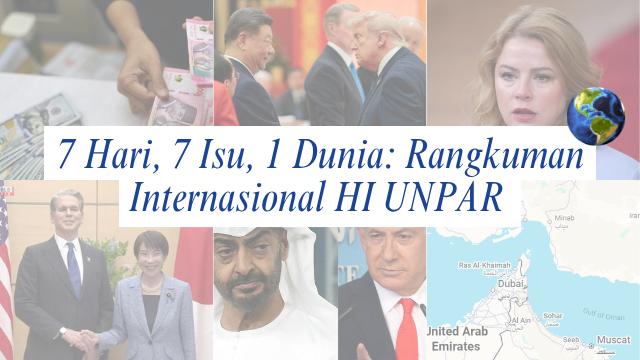
Over the past week, global developments have reflected intensifying geopolitical dynamics and interstate competition across various regions of the world. The rivalry between the United States and China once again came into the spotlight through a meeting between President Donald Trump and President Xi Jinping in Beijing on Wednesday (13/5). During the meeting, Xi Jinping introduced the concept of “constructive strategic stability” as a new framework for US–China relations that emphasizes cooperation, stability, and the careful management of competition. Xi also stressed that the Taiwan issue remains the most sensitive matter in bilateral relations and warned of the risks of conflict if it is not handled wisely. Meanwhile, Trump highlighted the importance of maintaining economic cooperation and trade relations between the United States and China.
A day before the visit to China, Japan and the United States also strengthened strategic coordination regarding the Indo-Pacific, supply chains, and developments in AI technology. US Treasury Secretary Scott Bessent met Japanese Prime Minister Sanae Takaichi in Japan. The 20-minute meeting discussed President Donald Trump’s visit to China, US–Japan relations, bilateral investment, critical minerals, and the Indo-Pacific situation. During the meeting, Takaichi emphasized the importance of strengthening both countries’ supply chains and minimizing the risks posed by high-performance AI models. Bessent also explained recent developments in US–China relations and reaffirmed that the US–Japan partnership remains strong.
Tensions were also visible in the Middle East, as Thailand urged Iran to allow eight stranded ships to safely pass through the Strait of Hormuz. The request was delivered by Thai Foreign Minister Sihasak Phuangketkeow to Iranian Foreign Minister Abbas Araghchi during a BRICS meeting in India. Iran expressed optimism that the shipping route would reopen following the achievement of a peace agreement with the United States. Tensions in the Strait of Hormuz have escalated since Iran closed the route in response to US and Israeli attacks on Iran.
Meanwhile, the United Arab Emirates denied claims made by Prime Minister Benjamin Netanyahu’s office regarding a secret visit by Netanyahu to the UAE, which had previously been announced through a social media statement. Through the state news agency WAM, the UAE emphasized that its relationship with Israel is conducted openly within the framework of the Abraham Accords and is not based on secret arrangements. Previously, Netanyahu’s office described the meeting with UAE President Sheikh Mohamed bin Zayed Al Nahyan as a “historic breakthrough” in bilateral relations. Amid rising regional tensions, security cooperation between Israel and the UAE has reportedly continued to expand, including the deployment of Israel’s Iron Dome defense system to the UAE to counter potential Iranian attacks.
In Europe, regional security concerns also affected domestic political dynamics in Latvia after Latvian Prime Minister Evika Siliņa resigned following controversy surrounding a drone incident allegedly linked to the Russia–Ukraine war. Earlier, Siliņa had dismissed Defense Minister Andris Spruds for being considered too slow in responding to the drone incident, which triggered a fire in eastern Latvia. Her resignation caused the government to lose its parliamentary majority amid growing regional security concerns resulting from the Russia–Ukraine conflict.
In the Caribbean, CIA Director John Ratcliffe met Cuban officials in Havana to discuss security cooperation and economic stability amid an energy crisis triggered by the US oil blockade. During the meeting, the United States once again offered aid worth US$100 million, while Cuba emphasized that economic conditions would improve if the blockade were lifted. Cuba’s fuel crisis has led to power outages, disrupted public services, and public protests in Havana. At the same time, the US has also increased pressure on the Cuban government through new sanctions and plans to indict former President Raúl Castro over the 1996 aircraft shooting incident.
Domestically, on Friday (15/5), the rupiah exchange rate against the US dollar reached Rp17,600. The weakening rupiah has increased industrial production costs, prompting many businesses to either raise prices or reduce product sizes. The situation has also affected tofu and tempeh producers in several regions due to rising imported soybean prices. Economists believe the rupiah’s depreciation has been influenced by external factors such as the Iran–US–Israel conflict, as well as domestic factors including fiscal uncertainty and capital outflows. Bank Indonesia and the government have therefore prepared various stabilization measures to maintain the exchange rate and reduce the impact on inflation and public purchasing power.
Source:
Gribben, Paul., dan Tom McArthur. “CIA chief visits Cuba as energy crisis worsens”. BBC. 15 Mei 2026. https://www.bbc.com/news/articles/cd7pyrj0vx7o.
“How stray Ukrainian drones pushed Latvia’s prime minister to resign”. France 24. 14 Mei 2026. https://www.france24.com/en/europe/20260514-how-stray-ukrainian-drones-pushed-latvia-prime-minister-resign.
“Negara Tetangga RI Desak Iran Izinkan 8 Kapal Lewat Selat Hormuz”. CNN Indonesia. 17 Mei 2026. https://www.cnnindonesia.com/internasional/20260517124719-106-1359276/negara-tetangga-ri-desak-iran-izinkan-8-kapal-lewat-selat-hormuz.
Siong, Lee Gim. “‘New positioning’ in Sino-US ties: What does ‘constructive strategic stability’ really mean?”. CNA. 14 Mei 2026. https://www.channelnewsasia.com/east-asia/trump-xi-summit-constructive-strategic-stability-us-china-6121716.
“Takaichi dan Bessent Bertemu Jelang Kunjungan Trump ke Cina”. NHK World Japan. 13 Mei 2026. https://www3.nhk.or.jp/nhkworld/id/news/20260512_16/.
“UAE denies Netanyahu visited in ‘secret’ during US-Israel war on Iran”. Aljazeera. 13 Mei 2026. https://www.aljazeera.com/news/2026/5/13/netanyahu-visited-uae-in-secret-during-us-israel-war-on-iran-office-says.
Wahyuni, Tri., dan M. Irham. “Rupiah cetak rekor terlemah, apa yang akan terjadi selanjutnya?”. BBC Indonesia. https://www.bbc.com/indonesia/articles/c5y9eexrq9zo.