


International political developments over the past week have demonstrated increasingly complex dynamics, marked by rising geopolitical tensions, shifting strategic alliances, and various domestic policies that affect interstate relations. Amid efforts by several actors to maintain regional stability, great-power rivalry and national interests continue to be the primary factors shaping the global landscape.
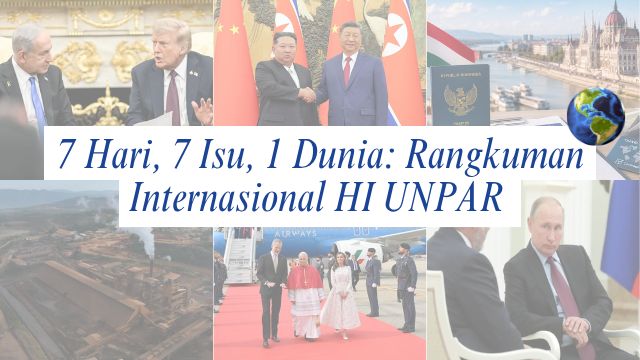
In the Middle East, relations between the United States and Israel came under the spotlight after U.S. President Donald Trump was reportedly involved in a tense phone conversation with Israeli Prime Minister Benjamin Netanyahu on Monday (1 June) regarding the escalation of conflict in Lebanon. Tensions intensified after Iran threatened to suspend negotiations due to Israel’s actions in Lebanon. Following the conversation, Netanyahu stated that Israel would strike targets in Beirut if Hezbollah continued its attacks, while Trump claimed that Netanyahu had canceled plans for a major operation in Beirut and emphasized that negotiations with Iran were still ongoing.
Meanwhile, in East Asia, Chinese President Xi Jinping is scheduled to make a state visit to North Korea on 8–9 June 2026, marking his first visit to the country in nearly seven years. The visit comes amid efforts by both countries to strengthen bilateral relations, while North Korea seeks to expand cooperation with China despite its growing ties with Russia. The visit also takes place one day after North Korea announced a new facility for producing nuclear weapons materials and reaffirmed its commitment to strengthening its nuclear capabilities.
In the Eurasian region, Russia has threatened to halt the supply of discounted oil and gas to Armenia if the country continues its efforts to join the European Union. The threat emerged ahead of Armenia’s parliamentary elections, as the country has grown closer to the United States and the European Union. As a form of pressure, Russia has already restricted imports of several Armenian products and warned of the possibility of Armenia being expelled from the Moscow-led Eurasian trade bloc.
In Western Europe, Pope Leo XIV began his official visit to Spain by praising the country’s commitment to peace, solidarity, and support for migrants. During the seven-day visit, the Pope is scheduled to meet victims of sexual abuse within the Catholic Church, deliver a speech before the Spanish Parliament, and attend commemorative events honoring migrants who died while attempting to reach Europe through the Canary Islands. He also stressed the importance of peace and addressing sexual abuse cases as part of the process of healing and justice.
In Central Europe, the Hungarian government began suspending the issuance of work visas for workers from the Philippines, Georgia, and Armenia starting Friday (5 June). The policy aligns with the government’s plan to tighten access to employment opportunities for guest workers due to concerns about its impact on local wage levels. The government described the measure as part of a long-term solution, although several foreign investors argued that restricting foreign labor could negatively affect companies and the national economy.
Indonesia also attracted international attention after three Australian nationals were set to be deported following the completion of prison sentences for entering South Papua without valid immigration documents. Two of them, Zulfukar Aljubouri and Duong Tan Le, were found guilty of entering Indonesia without visas, while pilot Jay Victor Davis was convicted for facilitating the flight. The Merauke District Court sentenced all three individuals to seven months in prison and imposed fines. After accounting for time already served, they are expected to be released and deported to Australia in the near future.
In the global economic sector, several Chinese nickel companies have begun exploring investment opportunities outside Indonesia amid growing uncertainty surrounding mining policies. Tsingshan Group is considering a nickel project in Madagascar, while Lygend Resources is exploring projects in Tanzania and New Caledonia. These moves come after investors faced a series of new regulations in Indonesia, including stricter mining quotas and proposed tax increases.
Source:
“Hungary to stop issuing worker visas to people from three countries starting Friday”. Reuters. 5 Juni 2026. https://www.reuters.com/business/world-at-work/hungary-stop-issuing-worker-visas-people-three-countries-starting-friday-2026-06-05/.
Lainufar. Inas Rifqia. “3 Pria Australia Didepak dari Indonesia, Masuk Papua Selatan secara Ilegal”. Kompas.com. 3 Juni 2026. https://internasional.kompas.com/read/2026/06/03/141830070/3-pria-australia-didepak-dari-indonesia-masuk-papua-selatan-secara.
McArthur, Tom. “Pope begins Spain visit with praise for country’s opposition to war and support for migrants”. BBC. 7 Juni 2026. https://www.bbc.com/news/articles/c8d2pgjy4qgo.
Muhaimin. “Rusia Ancam Armenia: Tak Lagi Dipasok Minyak Murah Jika Nekat Gabung Uni Eropa!”. Sindonews. 4 Juni 2026. https://international.sindonews.com/read/1713865/41/rusia-ancam-armenia-tak-lagi-dipasok-minyak-murah-jika-nekat-gabung-uni-eropa-1780553210?showpage=all.
Priambodo, Dhika., Zetta Hannany. “Raksasa nikel China mulai cari alternatif Indonesia ke Afrika”. IDN Financial. 5 Juni 2026. https://www.idnfinancials.com/id/news/64468/raksasa-nikel-china-mulai-cari-alternatif-indonesia-ke-afrika.
Scoot, Rachel., Katherine Faulders. David Brennan. “Trump cursed at Netanyahu in call over Lebanon escalation, sources say”. ABC News. 2 Juni 2026. https://abcnews.com/International/trump-cursed-netanyahu-call-lebanon-escalation-sources/story?id=133509005.
“Xi Jinping will travel to North Korea next week in first visit since 2019”. npr. 5 Juni 2026. https://www.npr.org/2026/06/05/g-s1-126481/xi-jinping-will-travel-to-north-korea-next-week-in-first-visit-since-2019.